money and politic

Tumblr ↗

  • Suez Canal Tokens at Heritage Auction

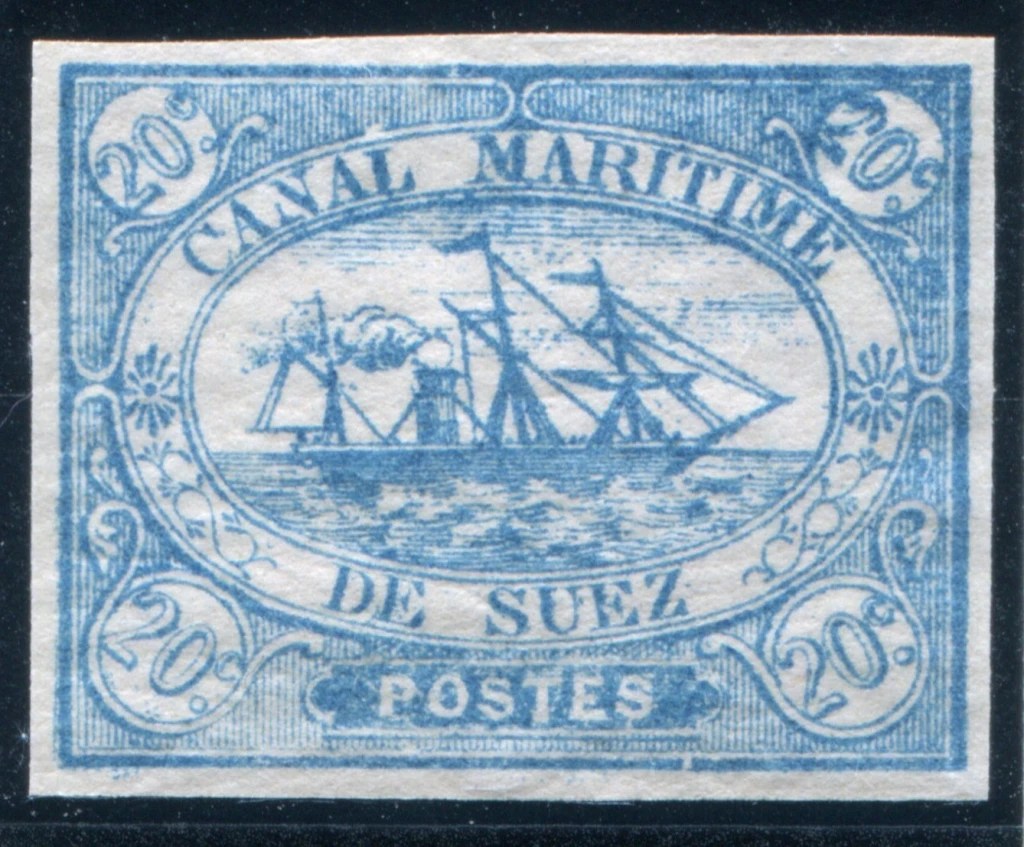
    Rare and historic Suez Canal tokens sold at a Heritage Auction on February 12-13, including this 50 centimes piece from Ch. & A. Bazin. These tokens were used by workers building the canal and were denominated in French Francs.

    The auction, “2024 February 12 – 13 The Lord Collection of Egyptian Coins Showcase Auction,” included rare 5 Franc pieces from both Bazin and Borel Lavalley series. The Bazin piece sold for $3,600, and the Borel Lavelley one went for $2,880. A 5 Franc Bazin piece sold on eBay in February 2022 for $4,035. The Borel Lavalley pieces are more commonly found for sale than the Bazin tokens.

  • End of war in Gaza?

    I hope so.

  • Ladder

    Exit only.

  • Split-level

    Ape cave entrance

  • United Nations Emergency Force Scrip

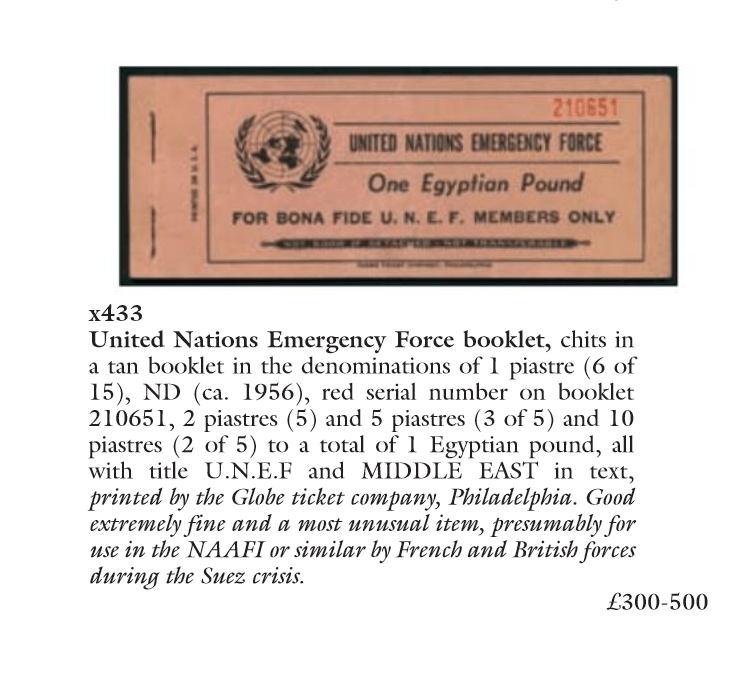
    This rare, historic emergency scrip was used during the 1956 Suez Crisis by the United Nations Emergency Force. It was created for UNEF peacekeepers to trade at camp stores in the Sinai Peninsula, Egypt.

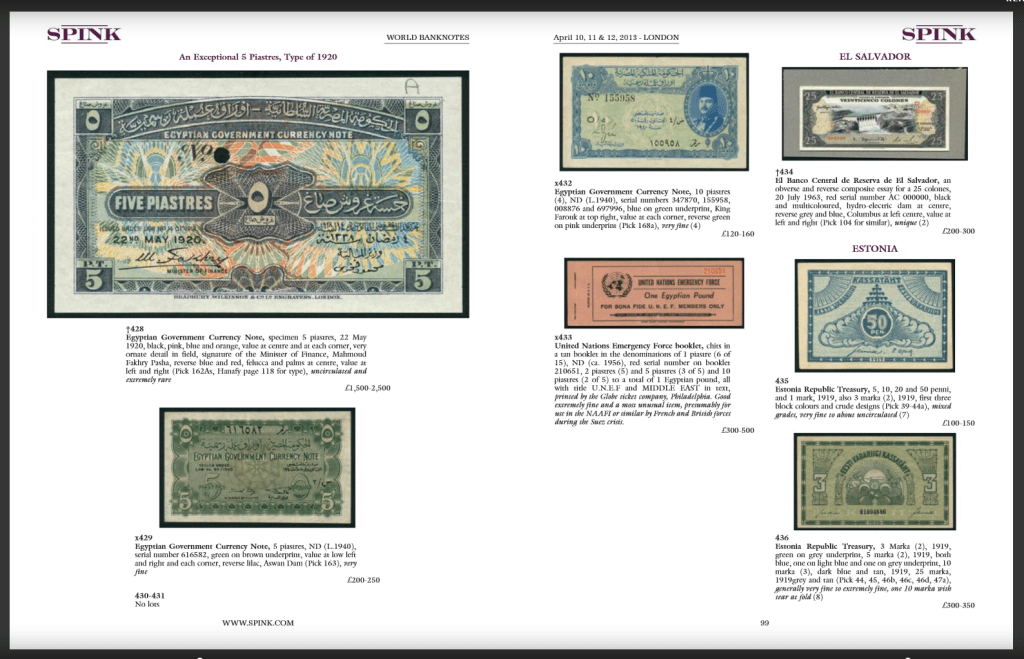
    A booklet of these scrips was listed at a Spink London auction in April 2013, but the lot went unsold. The auction catalog said the tickets were printed by the Globe ticket company in Philadelphia.

    Spink wrote about the piece, “a most unusual item, presumably for use in the NAAFI or similar by French and British forces during the Suez crisis.”

    A reader reported that the scrip was not used by British and French forces, since they were not part of the UNEF. Britain, France, and Israel invaded Egypt in 1956 and were not part of the peacekeeping forces. The peacekeepers came from Brazil, Canada, Colombia, Denmark, Finland, India, Indonesia, Norway, Sweden, and Yugoslavia. The reader reported the scrip was used by Canadian forces in their canteens.

    The UNEF was deployed as a response to the Suez Crisis and to maintain peace between Egypt and Israel. It was conceived by UN Secretary General Dag Hammarskjöld and Canadian Minister Lester B. Pearson, who would later win the Nobel Peace Prize for his effort.

  • Yellow Fever Emergency Coinage

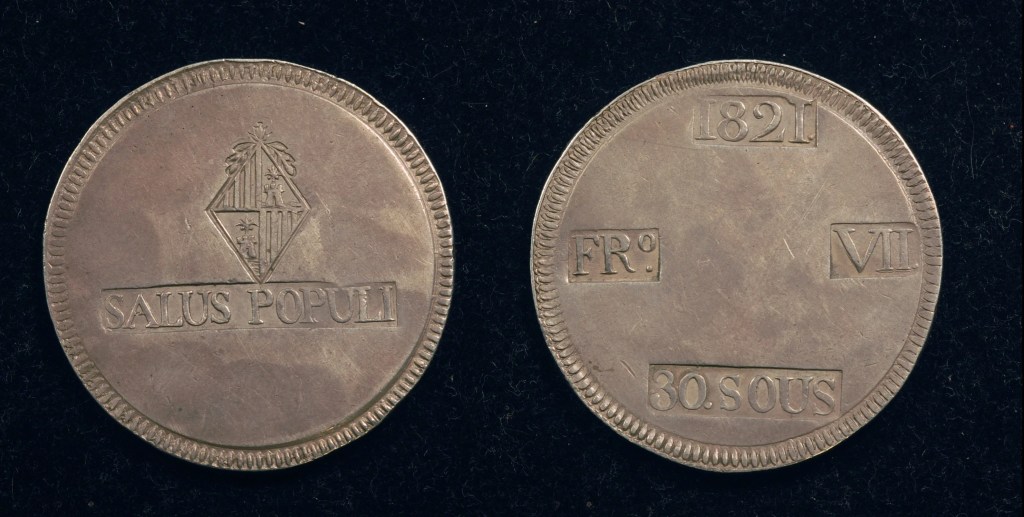
    In 1821, the city of Palma on the Spanish island of Mallorca was affected by an epidemic of yellow fever. Officials established quarantines to prevent the spread of the disease. To facilitate local trade while the island was under quarantine, the city of Palma authorized the mintage of a small number of silver coins by a temporary mint set up in Bellver Castle. The castle still stands today. The large silver coins were apparently made from silver taken from local churches.

    The obverse shows the Latin script, “SALUS POPULI,” which means “safety of the people.”

    The reverse shows the date 1821 and the denomination 30 SOUS. Depicted in the center is “FR VII” for King Ferdinand VII.

    References:
    https://www.ncbi.nlm.nih.gov/pmc/articles/PMC6113753
    https://en.numista.com/catalogue/pieces26340.html
    https://en.wikipedia.org/wiki/Bellver_Castle

  • Hello, world

    Money is a tale as old as time.