This is a 1 Franc token from the Suez Canal Cooperative Society in Egypt. It was issued in 1892 and is made of aluminum.
The canal was completed decades before 1892. These pieces must have been used by co-op workers at the operating canal.
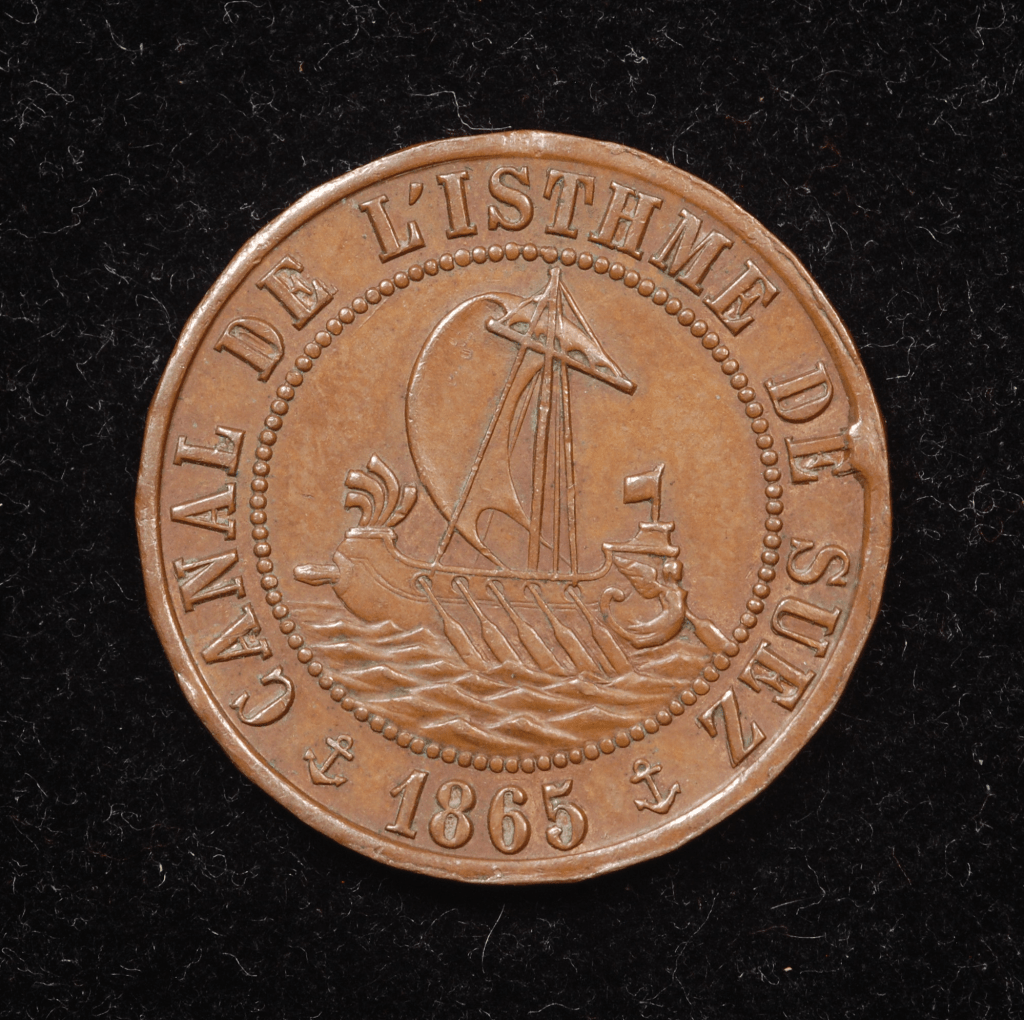
There are two other token sets that circulated during the 10-year construction of the canal (1859 to 1869). Those tokens are dated 1865. One set is from “Ch. & A. Bazin” and the other from “Borel Lavalley and Co.”
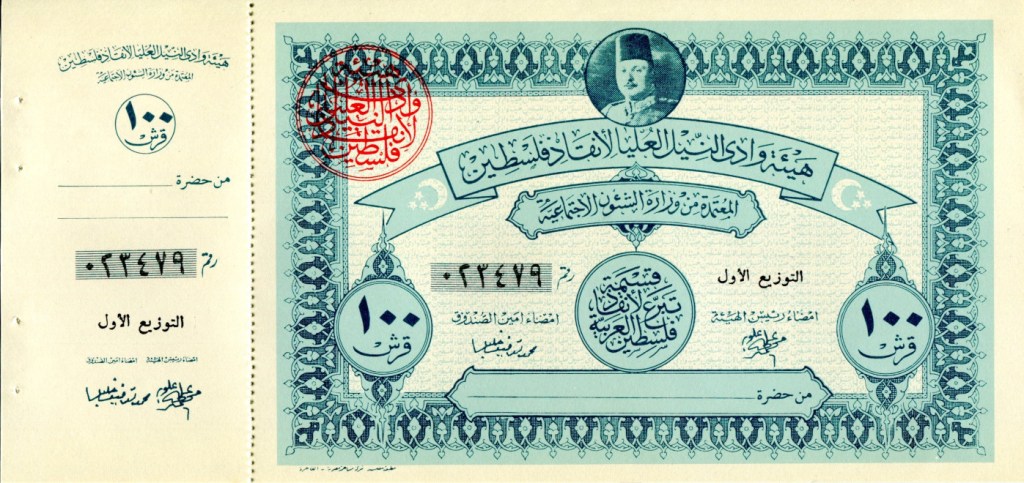
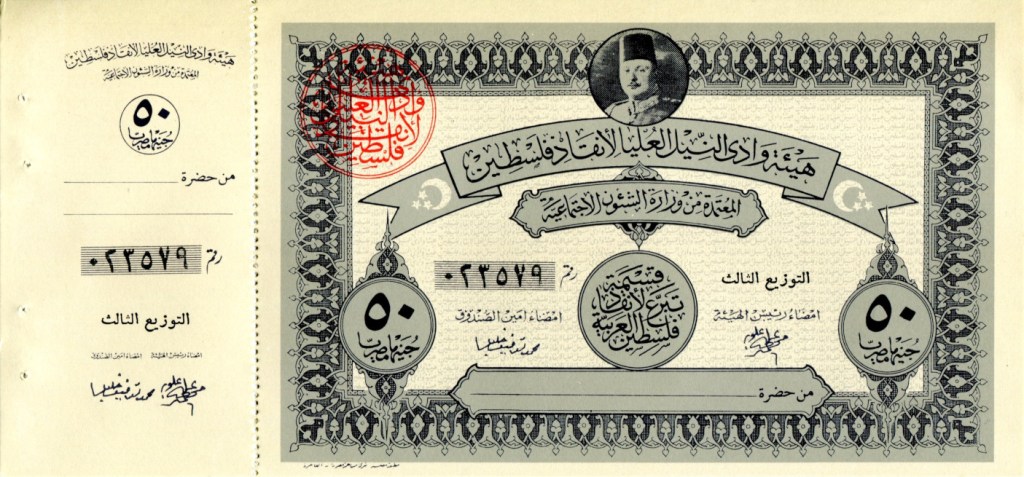
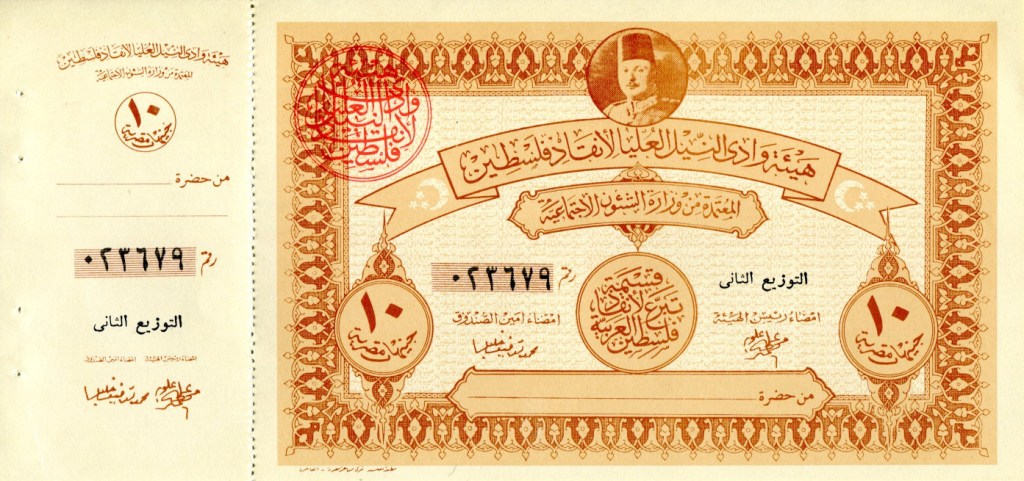
I believe this is an Egyptian bond from the 1940s, or donation receipt, for people to support the war in Palestine. I bought this one off eBay. The note’s denomination is 10 pounds.
I’m interested in learning if these notes were bonds that got paid back or if they were donation receipts. I’ve read descriptions online stating both.
The bonds come in denominations of 50 Pounds, 10 Pounds, 5 Pounds, 100 Piasters, and 50 Piasters.
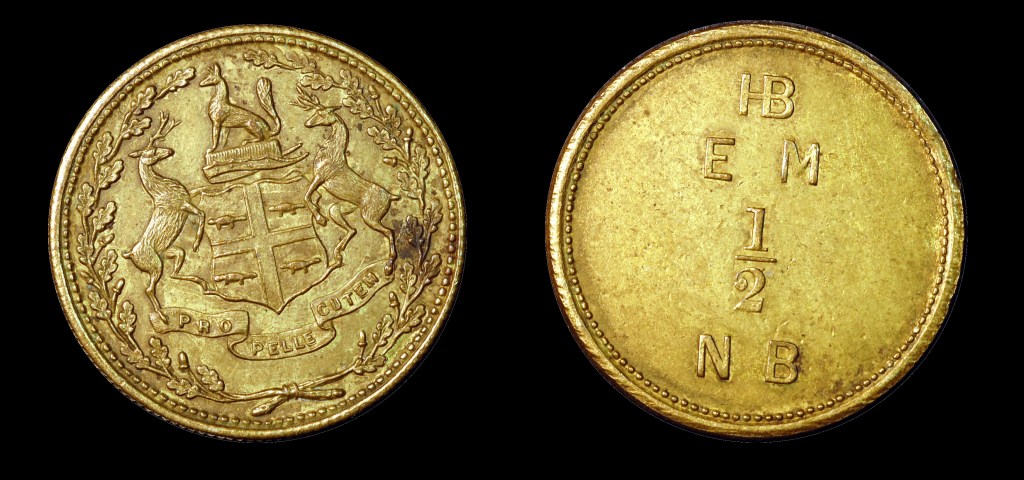
This Canadian token from around 1857 was worth ½ of a Made Beaver for fur trappers in the land east of Hudson Bay. It was part of a vast region of British North America called Prince Rupert’s Land. The Hudson’s Bay Company was gifted exclusive trading rights to all lands within the watersheds of Hudson’s Bay and the Hudson’s Bay Straits.
A Made Beaver is a unit of value created to facilitate trade between the Hudson’s Bay Company and trappers. It was worth a high quality, large beaver skin. Trappers exchanged them for company goods.
Some of the tokens have a punch mark on the denomination side, between the N and B. It is thought these punched pieces were used in a different region.
One side of the token shows the crest (coat of arms) of the Hudson’s Bay Company. Motto: Pro Pelle Cutem Latin, meaning ‘a pelt for a skin.’
HB: Hudson Bay EM : East Main district ½: denomination NB: made beaver, die cutter error
These pieces are rare. This example has a some mint luster left. It also has a dark spot that I would love to remove, but have not been able to.
During the British Mandate of Palestine, the Palestine Currency Board produced banknotes with values of 500 mils, 1 pound, 5 pounds, 10 pounds, 50 pounds and 100 pounds.
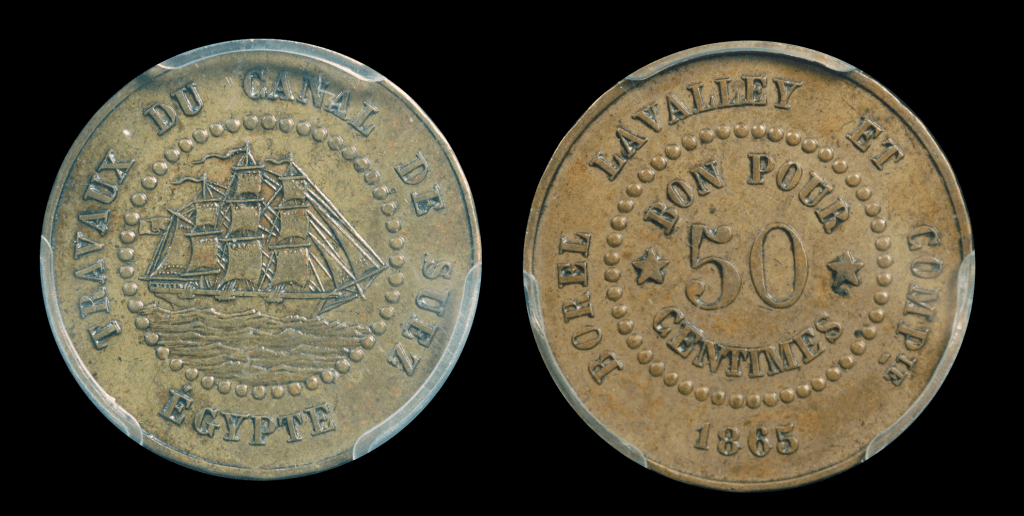
This rare token was issued by Borel, Lavalley, and Company, an engineering firm and contractor to the Suez Canal Company. Frenchman Ferdinand de Lesseps and his Suez Canal Company built the canal between 1859 and 1869.
Paul Borel and Alexandre Lavalley formed their company in December 1863. Graduates of a polytechnic school, both worked in the railway industry before joining the canal project. An estimated 74 million cubic meters of material was excavated for the main canal, and Borel and Lavalley handled more than 75 percent of it. (Karabell, 2004, p. 208-210.)
The company issued trade tokens, presumably for workers to buy provisions at the company store. Tokens are good for 20 cents, 50 cents, 1 Franc, or 5 Francs. The 5 Franc pieces are the most rare.
Shown here is a 50 cent piece. The obverse depicts a ship in the center, surrounded by beads and an inscription: TRAVAUX DU CANAL DE SUEZ EGYPTE
Translation: WORKS ON THE SUEZ CANAL EGYPT
The reverse shows the denomination, a circle of beads, and an inscription: BOREL LAVALLEY ET COMPIE BON POUR 50 CENTIMES 1865
Translation: BOREL LAVALLEY AND COMPANY GOOD FOR 50 CENTS 1865
Reference: Karabell, Z. (2003). Parting the Desert: The Creation of the Suez Canal. Knopf.
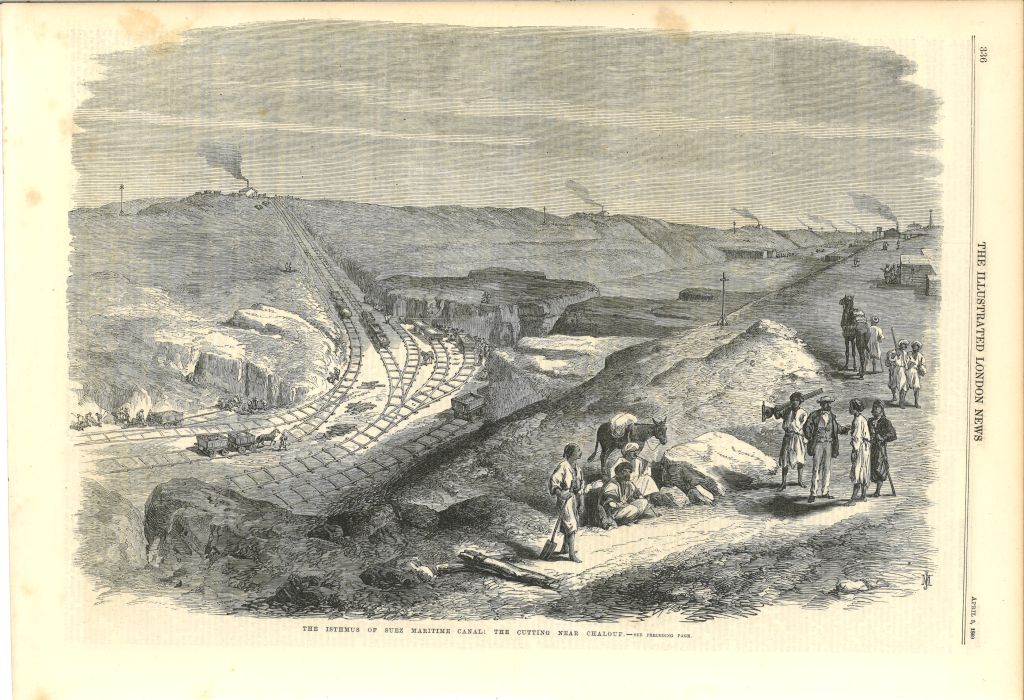
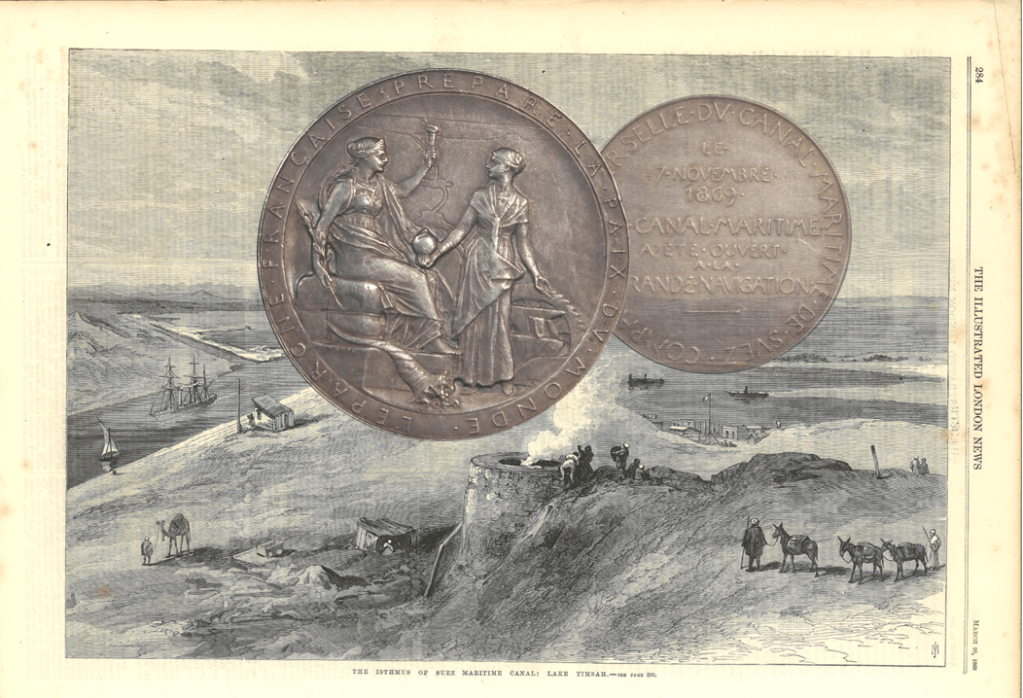
This woodblock engraving from April 3, 1869, shows the Suez Canal nearing completion. I am interested in the history of the canal and the people who built it. I have a few tokens used by workers at the company store.
Laborers are shown removing rock in a section of the canal. The canal, 164 kilometers long and 8 meters deep, was an enormous engineering challenge. The waterway passed through mostly sand and low lying lakes and rivers connecting the Mediterranean Sea to the Red Sea,
The canal took 10 years to build. Ferdinand de Lesseps formed the Suez Canal Company to finance and build the canal. The company completed it in November 1869, seven months after this newspaper was printed.
A construction company called Ch. & A. Bazin issued this French Franc token in 1865. It can be found in denominations of 5 Francs, 1 Franc, 50 Centimes, and 20 Centimes.
The balemark or merchant’s mark on a 1791 coin from British India. This is a 2 Pice coin from the Bombay Presidency.
The mark identified products from the United East India Company as they were sold around the world. It was also called a “chop” derived from a Hindi word for “stamp.”








 bishquid